ATO DEBT
ATO debt help for company directors
Authored by Patrick Loi, Managing Principal and Registered Liquidator, Greengate Advisory · Updated 18 September 2026

Authored by Patrick Loi, Managing Principal and Registered Liquidator, Greengate Advisory · Updated 18 September 2026
If your company owes the ATO, you can pay in full, ask for a payment plan, restructure, or wind up. Acting before the ATO issues a director penalty notice keeps the most options open.
If your company owes the ATO, the options narrow the longer it is left. Our registered liquidators help small and medium business directors understand where they stand, what the ATO can do next, and which option fits: a payment plan, a restructure, or an orderly wind-up. We work in English, Mandarin, Cantonese and Korean.
| Option | When it can fit | What it means for you |
|---|---|---|
| Payment plan | The business is viable and can meet regular instalments | You can often arrange a payment plan. However, interest keeps accruing. This may be difficult to achieve if your business is not viable |
| Small business restructuring (SBR) | Total liabilities are $1 million or less, employee entitlements are paid and tax lodgements are up to date | Directors stay in control while a restructuring practitioner helps prepare a plan for creditors to vote on |
| Voluntary administration | Larger or more complex businesses that may be saved or sold | An independent administrator takes control and creditors decide the company’s future |
| Liquidation | The business cannot continue | An orderly wind-up; a liquidator deals with creditors and investigates the company’s affairs |
For smaller debts, many businesses can set up a payment plan by contacting the ATO. For larger debts, however, you need to negotiate with the ATO. The ATO will usually want to see that lodgements are up to date and that the plan is realistic. Interest keeps accruing on the unpaid balance. Also, missing an instalment can bring back firmer action. Also, a payment plan does not remit a director penalty the ATO has already issued. ATO payment plans explained.
A garnishee notice directs a bank or a customer who owes your company money to pay it to the ATO instead. It can arrive with little warning. As a result, it can stop the business paying wages and suppliers. So if you receive one, get advice straight away: options include negotiating with the ATO or, where the business cannot recover, a formal appointment. ATO garnishee notices explained.
Greengate Advisory is an Australian restructuring and insolvency firm led by registered liquidators. We advise company directors on company ATO debt, including payment arrangements, restructuring and director penalty risk. Our offices are in Sydney (Suite 2, Level 32, 31 Market Street, Sydney NSW 2000, (02) 8318 3699) and Brisbane (Suite 5GB, Level 5, 199 George Street, Brisbane QLD 4000, (07) 3868 1888), and we act for companies across Australia. The first consultation is free and confidential, in English, Mandarin, Cantonese or Korean. Contact us or email info@ggadvisory.com.au.
Rarely. The ATO may remit some interest and penalties, but it generally does not write off a company’s tax debt. A restructuring plan accepted by creditors, including the ATO, can reduce what the company pays. Can ATO debt be reduced?.
It can, if at least $100,000 is more than 90 days overdue and the business is not engaging with the ATO. You get 28 days’ written notice first. ATO credit reporting explained.
Your accountant is the right first call for lodgements and payment plans. Speak to a registered liquidator when the debt is more than the business can pay from its cash flow, or when a DPN or garnishee notice has arrived.
Example: a Sydney family manufacturer owing about $2.5 million to the ATO was restructured through voluntary administration and a deed of company arrangement. Read the case study.
Authored by Patrick Loi, Managing Principal and Registered Liquidator. Patrick has over 20 years of business restructuring and insolvency experience and founded Greengate Advisory. Meet our team.
Speak confidentially with a registered liquidator
Sydney and Brisbane · English, 中文, 한국어
This page is general information, not advice about your situation.
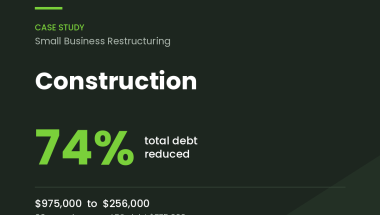
A plumbing contractor with more than 60 employees and over $10 million in turnover reduced about $975,000 of debt to about $256,000 through small business restructuring.

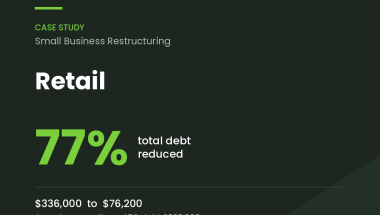
An aquarium supplies retailer trading online and from a showroom reduced about $336,000 of debt to $76,200 through a small business restructuring plan.
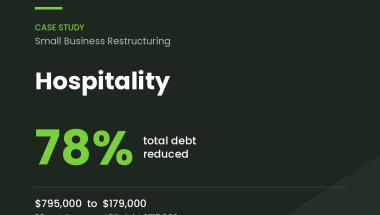
A restaurant employing 29 people reduced about $795,000 of debt, including $715,000 owed to the ATO, to about $179,000 through a small business restructuring plan.
Each co-owner is entitled to possess the whole property, so living there is not, by itself, a reason to pay the other co-owner. But the court can charge an occupation...
To buy out a co-owner, you agree a price for their share, usually based on a current valuation less their share of the mortgage and adjusted for what each of...
When a co-owner becomes bankrupt, their trustee in bankruptcy becomes the owner of the bankrupt’s share of the property, and the other co-owner cannot deal with the property without the...
Contact us for a free confidential consultation with one of our experts.
You can discuss your position and all possible options
in your language – Chinese, Korean, English and other Asian languages.
Get in touch today with experts that understand your needs.
Let us help you navigate through times of uncertainty.