Short answer: Restructuring changes how a business deals with its debts so it can keep trading. The main formal options are voluntary administration, a deed of company arrangement (DOCA) and, for companies with debts under $1 million, the small business restructuring process. Seeking advice early leaves the most options open.
Financial distress is common at some point in a business’s life, especially in uncertain times.
Even in good economic conditions, running a business involves risk, and insolvency is a real possibility for many Australian businesses. However, with the right advice at the right time, you can often reduce that risk, protect the value of the business and recover.
On the other hand, problems left unmanaged can quickly become a crisis, leading to liquidation or even personal bankruptcy. For this reason, if your business is in financial difficulty, get advice as early as possible. That way, you can look at every option and act quickly to restructure and turn the business around.
Specialist Restructuring & Turnaround Solutions
Change is hard, and restructuring a business can feel daunting. Still, it may be the best way through a difficult period. Moreover, with the right approach, you can reduce risk, protect value and recover.
First, we analyse how the business is performing and find the root causes of the problem. Then we work out which restructuring options suit your situation and develop a strategy with you. Throughout the process, we explain each step and the issues that come with it.
Voluntary Administration
Voluntary administration gives a company breathing space to work out its future. An independent voluntary administrator takes control of the company, investigates its business and financial affairs, and reports to creditors. Then, at the second creditors’ meeting, creditors decide whether the company returns to the directors, goes into liquidation or enters a deed of company arrangement. See our voluntary administration guide.
Deed Of Company Arrangement (DOCA)
A DOCA follows a voluntary administration. It is a binding arrangement between a company and its creditors that governs how the company’s affairs will be dealt with. As a result, the business can often keep trading as a going concern while it turns its finances around. See our DOCA guide.
Small Business Restructuring Process (SBRP)
The Australian Government introduced small business restructuring to help small businesses in financial distress. In particular, it lets eligible companies with debts of $1 million or less put a restructuring plan to creditors while the directors stay in control. See our SBR guide.
Safe Harbour Restructures
Safe harbour can protect directors from personal liability for insolvent trading while they develop and take a course of action that is reasonably likely to lead to a better outcome for the company than an immediate administration or liquidation. In other words, it encourages directors to get advice early and restructure viable businesses, instead of closing them down too soon.
Why Greengate Advisory
We focus on helping small and medium businesses in Australia through financial difficulty. Our team quickly looks at the restructuring options available and, together with you, puts in place a strategy that considers every stakeholder.
Our team includes registered liquidators, Chartered Accountants, Certified Practising Accountants and ARITA professional members. They have worked on a wide range of restructuring and turnaround appointments for small and medium businesses in Australia, alongside directors, shareholders, creditors, employees and customers. As a result, you receive clear information and recommendations on each option, and a practical strategy for your business.
Getting the right advice early is crucial. In fact, the quality of that advice can change the outcome for your business.
Contact our restructuring team today for a free confidential consultation in Chinese, Korean, English or another Asian language. Acting now can make a real difference to your business’s future.
Common questions
What is business restructuring?
Changing how a business is financed, structured or run so it can return to profitability and deal with its debts. It can be informal, for example negotiating with creditors or cutting costs, or use a formal process such as small business restructuring or voluntary administration.
What is a restructuring practitioner?
A registered liquidator who acts as the small business restructuring practitioner for a company. They help the directors prepare a restructuring plan and put it to creditors, while the directors stay in control of the business. See our small business restructuring guide.
What is corporate debt restructuring?
Agreeing new terms for a company’s debts, such as reducing the amount owed or allowing more time to pay. It can be negotiated informally with creditors, or done through a formal process such as small business restructuring or a deed of company arrangement.
Can a company restructure its ATO debt?
Often, yes. Depending on the company’s position, the options include an ATO payment plan, small business restructuring for companies owing $1 million or less, or voluntary administration and a deed of company arrangement. See our ATO debt guide.
Do directors stay in control during a restructure?
In an informal restructure and in small business restructuring, yes. In voluntary administration, the administrator takes control, and under a deed of company arrangement, the directors’ control depends on the terms of the deed.
When should a business get restructuring advice?
When cash flow problems or tax debts first appear. The earlier you get advice, the more options you usually have, and the more time there is to put a plan to creditors.
Case studies
See how we help our clients secure
a better outcome
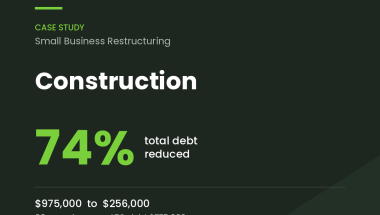
Restructuring a Plumbing Contractor with a $775,000 ATO Debt
A plumbing contractor with more than 60 employees and over $10 million in turnover reduced about $975,000 of debt to about $256,000 through small business restructuring.
21 September, 2026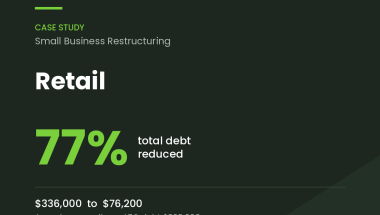
Restructuring an Aquarium Retailer with a $309,000 ATO Debt
An aquarium supplies retailer trading online and from a showroom reduced about $336,000 of debt to $76,200 through a small business restructuring plan.
21 September, 2026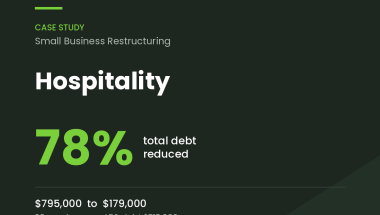
Restructuring a Restaurant with 29 Employees and $795,000 in Debt
A restaurant employing 29 people reduced about $795,000 of debt, including $715,000 owed to the ATO, to about $179,000 through a small business restructuring plan.
21 September, 2026

News & insights
Explore the latest insights, news and advice
and resources from our experts
Occupation fees and credits when one co-owner lives in the property
Each co-owner is entitled to possess the whole property, so living there is not, by itself, a reason to pay the other co-owner. But the court can charge an occupation...
16 October, 2026Buying out a co-owner in NSW: how it works and what happens if they refuse
To buy out a co-owner, you agree a price for their share, usually based on a current valuation less their share of the mortgage and adjusted for what each of...
16 October, 2026Bankruptcy and jointly owned property: what happens to a co-owner’s share
When a co-owner becomes bankrupt, their trustee in bankruptcy becomes the owner of the bankrupt’s share of the property, and the other co-owner cannot deal with the property without the...
16 October, 2026
If you’re in a distressed situation,
it’s essential to act quickly.
Contact us for a free confidential consultation with one of our experts.
You can discuss your position and all possible options
in your language – Chinese, Korean, English and other Asian languages.
Get in touch today with experts that understand your needs.
Let us help you navigate through times of uncertainty.