Director Penalty Notice Help – Sydney & Brisbane
The ATO is issuing director penalty notices at record levels: more than 84,000 in 2024–25, and more than 62,000 in just the first nine months of 2025–26. If one has arrived, the date on it matters more than anything else.
Received a director penalty notice? Act before day 21.
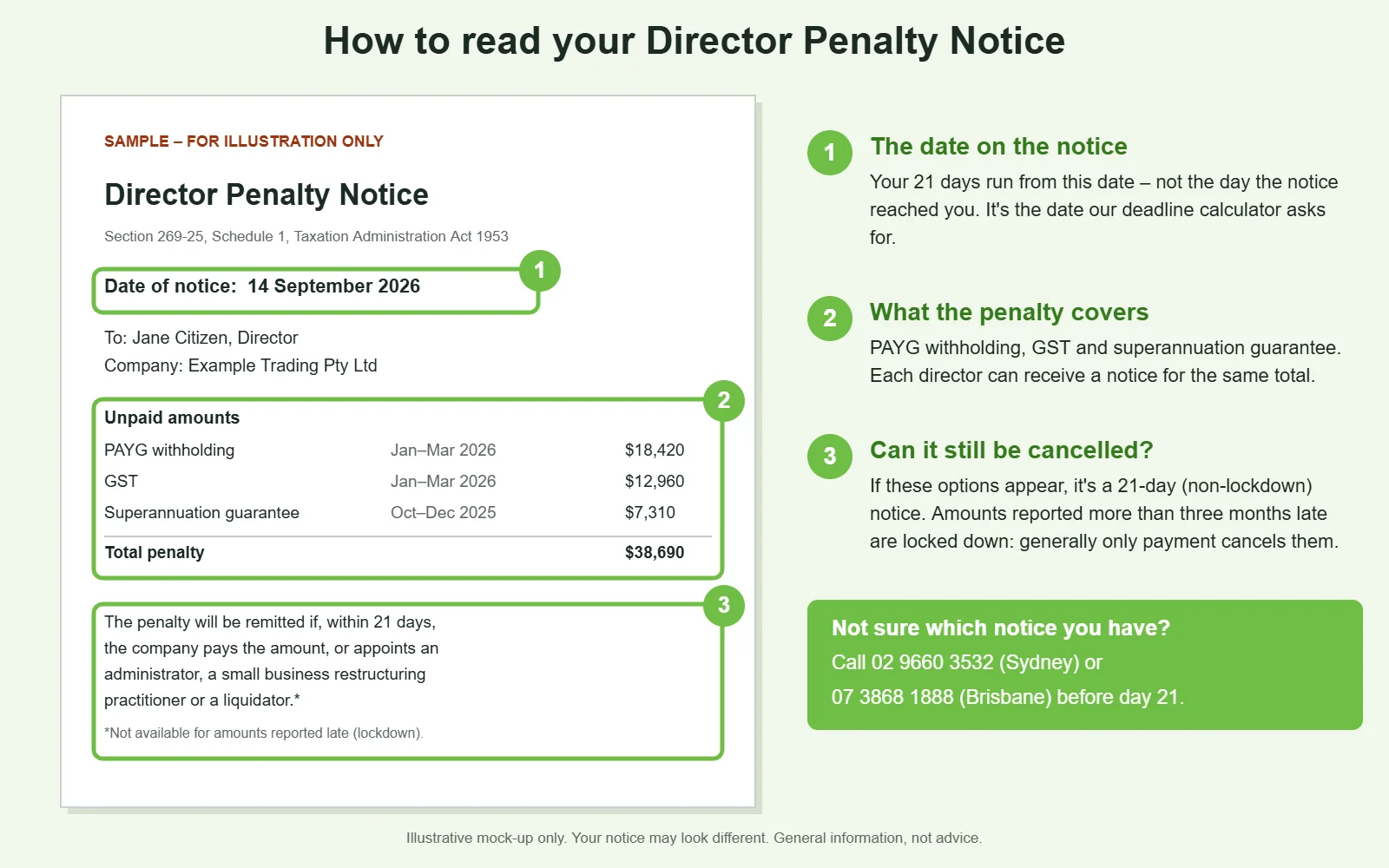
A director penalty notice (DPN) makes you personally liable for your company’s unpaid PAYG withholding, GST or super guarantee charge. For most notices you have 21 days from the date printed on the notice, not the day it reached you, to have the penalty cancelled. After that, the ATO can pursue you, your bank account and your tax refunds.
Talk to a registered liquidator today. We will tell you which type of notice you have, the exact date that matters, and what each option would mean for you and your company.
Book a free 30-minute call with Luke
Free, confidential first consultation · Registered liquidators · Offices in Sydney and Brisbane, acting for directors across Australia
Director penalty notices explained in 60 seconds
Presented by Patrick Loi, Registered Liquidator. General information only, not legal or financial advice.
Which notice do you have?
Non-lockdown (21-day) notice
The company reported its PAYG withholding and GST within three months of the due date, and lodged any super guarantee charge statement on time, but has not paid.
You can still have the penalty cancelled if, within 21 days, the debt is paid or the company appoints an administrator, a small business restructuring practitioner or a liquidator.
Lockdown notice
The amounts were not reported in time. The penalty is already locked in.
Appointing an administrator or liquidator will not cancel it. Generally only payment does. There can still be defences and ways to manage the debt, so get advice quickly.
Your options within the 21 days
The company pays the amount in the notice. Simplest, if the money is there.
For eligible companies with liabilities under $1 million. You keep running the business while a plan goes to creditors.
An administrator takes control and creditors decide the company’s future, often through a deed of company arrangement.
For a company that cannot continue. The business is closed and its affairs wound up.
A payment plan with the ATO does not cancel the penalty. The right option depends on whether the business is viable, what else it owes and your personal position, which is why the first conversation matters.
If you do nothing
Once the 21 days pass, the ATO can sue you personally, issue a garnishee notice to your bank, or use your personal tax refunds to reduce the penalty. An unpaid judgment can lead to bankruptcy. Every director of the company can receive their own notice for the same debt.
“In more than 20 years in the insolvency industry, I have seen the same thing again and again: the directors who come to us early have the most options. A director penalty notice is a serious warning, but it is not the end of the story. Early advice gives a business its best chance of survival, and acting before day 21 is often what separates a company that can be restructured from one that has to close.”
How we help
-
Read the notice with you
Call us, or send your details below. We confirm the notice type, the date that matters and what it covers.
-
Compare the options
Paying, restructuring, administration or liquidation. We explain what each means for you and the company, and what it costs, before anything starts.
-
Act before day 21
If an appointment is right, we can usually put it in place well inside the deadline. If it is not, we tell you.
Talk to a person, not a call centre

Sydney & New South Wales
Luke D’Costa, Senior Manager – Debt Strategist
Luke has more than 16 years’ experience in insolvency, helping people whose debts have become personal, which is exactly where a director penalty notice puts you. He holds ARITA’s Advanced Certificate in Insolvency and a Bachelor of Business and Commerce (Accounting) from Western Sydney University.
Suite 2, Level 32, 31 Market Street, Sydney NSW 2000
Brisbane & Queensland
Greengate Advisory Brisbane office
Suite 5GB, Level 5, 199 George Street, Brisbane QLD 4000
What clients say about Greengate
Reviews from our Google Business Profile, updated automatically.


Request a free DPN review
Thank you. We have your details.
We will call you as soon as possible during business hours. If day 21 is close, please call now.
Common questions
How long do I have to respond to a director penalty notice?
For a non-lockdown notice, you have 21 days from the date printed on the notice, not the date you received it. If none of the steps that cancel the penalty happen within those 21 days, the ATO can start recovering the penalty from you personally.
What is the difference between a lockdown and a non-lockdown DPN?
If the company reported its PAYG withholding and GST within three months of the due date, and lodged any super guarantee charge statement on time, the notice is usually non-lockdown: the penalty can be cancelled by paying, or by appointing an administrator, a small business restructuring practitioner or a liquidator within 21 days. If those amounts were not reported in time, the penalty is locked down and generally only payment cancels it.
Does a payment arrangement with the ATO cancel the penalty?
No. A payment plan does not cancel a director penalty. It may stop the ATO from taking recovery action while the plan is kept up, but the personal liability remains until the debt is paid.
I have just become a director. Am I liable for debts from before I joined?
A new director has 30 days from appointment before they become liable for amounts the company already owed. After that, the director penalty rules apply to them in the same way as to existing directors.
What can the ATO do if I miss the deadline?
The ATO can sue you personally, issue a garnishee notice to your bank, or use your personal tax refunds to reduce the penalty. An unpaid judgment can lead to bankruptcy proceedings.
Is the first conversation free?
Yes. The first consultation is free and confidential. We read the notice with you, confirm which type it is and the date that matters, and explain the options before you decide anything.
Sources: Taxation Administration Act 1953 (Cth), Schedule 1, Division 269; ATO guidance on director penalties; Inspector-General of Taxation and Taxation Ombudsman, review of the ATO’s administration of director penalty notices (2024–25 figures); ATO data for 1 July 2025 to 31 March 2026 as reported by industry sources. This page is general information, not advice for your circumstances. Reviewed by Patrick Loi, Registered Liquidator, Greengate Advisory. Last reviewed October 2026.